Replacing a Missing Tooth: What Are the Available Options and How Do You Choose the Right One?
A missing tooth can be replaced in several ways, including a dental implant, a dental bridge, or a removable denture․
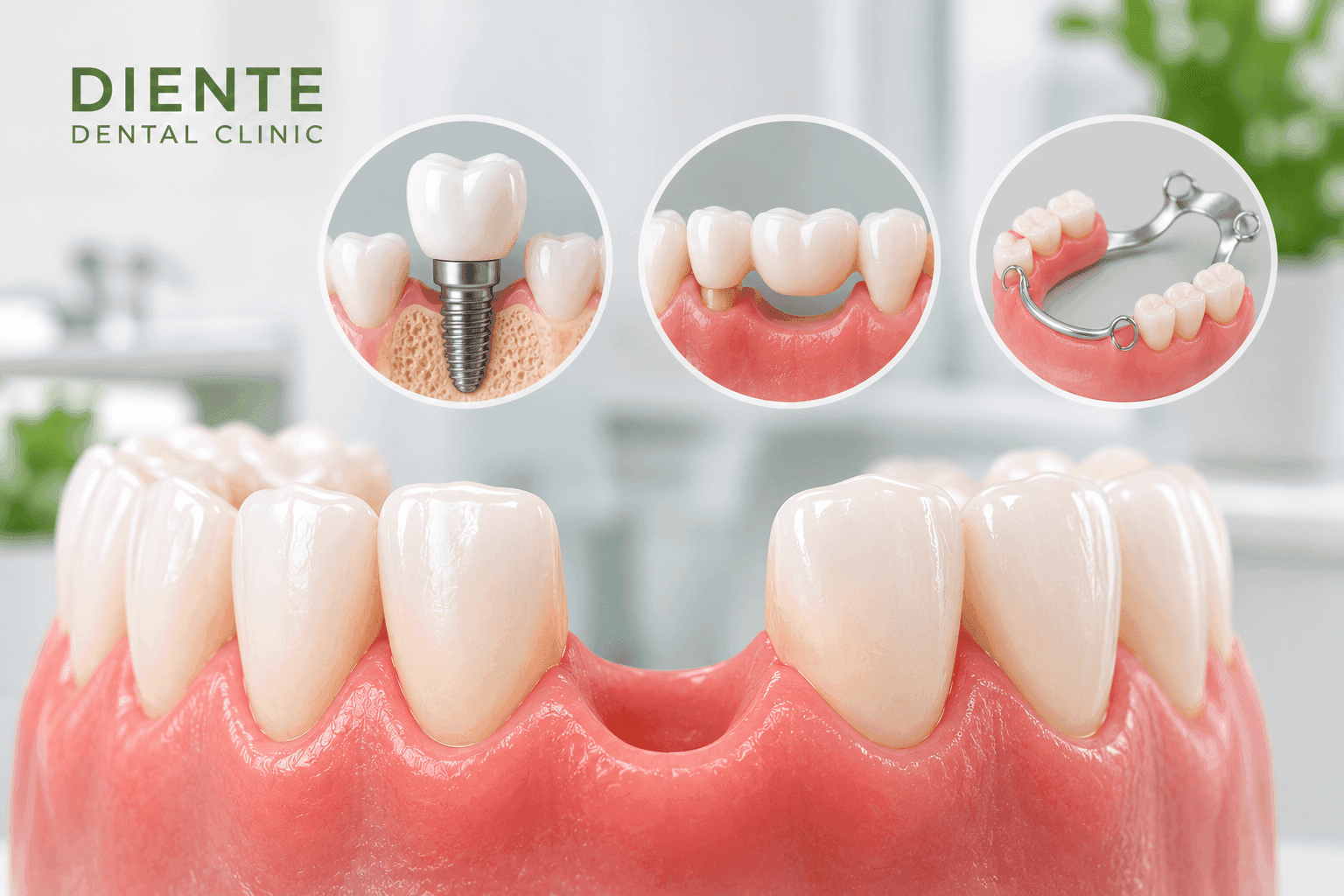
What are the options for replacing a missing tooth?
The choice of treatment depends on the number of missing teeth, the condition of the surrounding teeth and gums, the amount of jawbone available, and the patient's overall health.
1. Dental implant
A dental implant is an artificial support placed in the jawbone to replace the root of a missing tooth. Once the implant has integrated with the bone, an artificial crown is attached to it, restoring the appearance and function of the tooth.
This option can be used to replace one or several missing teeth. One of its main advantages is that the neighboring natural teeth usually do not need to be altered.
Whether an implant can be placed depends on the condition of the jawbone, gum health, and other general health factors. In some cases, additional preparatory treatment may be necessary, including bone grafting.
2. Dental bridge
A dental bridge is a fixed restoration used to replace one or several missing teeth. It is attached to the teeth next to the gap, which serve as supports for the restoration.
This method may be suitable when the neighboring teeth are strong enough to support the bridge. However, placing a conventional dental bridge usually requires preparing the supporting teeth, even if they were previously healthy.
Adhesive dental bridges are also available. In certain cases, they can be attached to the inner surfaces of neighboring teeth without extensive preparation. Their suitability depends on the specific clinical situation.
3. Removable partial denture
A removable partial denture is designed to replace one or several missing teeth. It can be taken out and put back in by the patient for cleaning and maintenance.
The denture may be supported by the remaining natural teeth and the tissues of the mouth. This option may be considered when several teeth are missing or when fixed dental restorations are not suitable.
4. Complete denture or implant-supported denture
If all the teeth in one jaw are missing, a complete removable denture may be used. It is custom-made and rests on the gums and corresponding areas of the jaw.
Another option is an implant-supported denture. In this case, dental implants provide additional support and stability. Depending on the chosen design, the denture may be removable or fixed.
Why is it important to replace a missing tooth in a timely manner?
A missing tooth can gradually affect the position of neighboring teeth and the distribution of chewing forces. In some cases, adjacent teeth may tilt or shift toward the empty space, while the opposing tooth may move downward or upward into the gap.
After a tooth is lost, the jawbone in that area may also gradually decrease in volume because it no longer receives the chewing forces previously transmitted through the tooth root.
However, the rate and extent of these changes vary from person to person. In addition, not every missing tooth necessarily needs to be replaced. For example, when certain wisdom teeth are absent, treatment may not be necessary. The decision is made after an individual assessment.
How do you choose the right replacement option?
There is no single treatment method that is best for every patient. Before treatment, the dentist evaluates the condition of the mouth, the strength of the neighboring teeth, gum health, and the characteristics of the jawbone.
If necessary, an X-ray or additional imaging examination is performed. The dentist then explains the available options, taking into account their advantages, limitations, treatment duration, and ongoing care requirements.
Frequently asked questions
Can a single missing tooth be replaced without altering the neighboring teeth?
Yes. A dental implant can be used to replace a single missing tooth without altering the neighboring natural teeth. However, whether an implant can be placed depends on the condition of the jawbone and gums.
Which is better: a dental implant or a dental bridge?
Both options can be effective, but they are suitable for different clinical situations. An implant usually does not require preparation of the neighboring teeth, whereas a dental bridge is supported by them. The choice depends on the patient's individual circumstances.
Can several missing teeth be replaced?
Yes. Depending on the number and position of the missing teeth, treatment may involve several dental implants, an implant-supported bridge, or a removable partial denture.
Restore your smile with the right solution
If you are missing one or several teeth, it is important to consult a dental professional in a timely manner to assess the available replacement options.
Diente Dental Clinic is a dental clinic located in Artashat, where you can consult a dentist, discuss options for replacing missing teeth, and receive an individualized treatment plan.
The clinic offers a free consultation and a free X-ray examination. The need for an X-ray is determined by the dentist based on clinical indications.
Address: 75/3 August 23 Street, Artashat
Phone: 055 665 488
Website: diente.am
Book your free consultation at Diente Dental Clinic to find out which tooth replacement option is right for your situation.